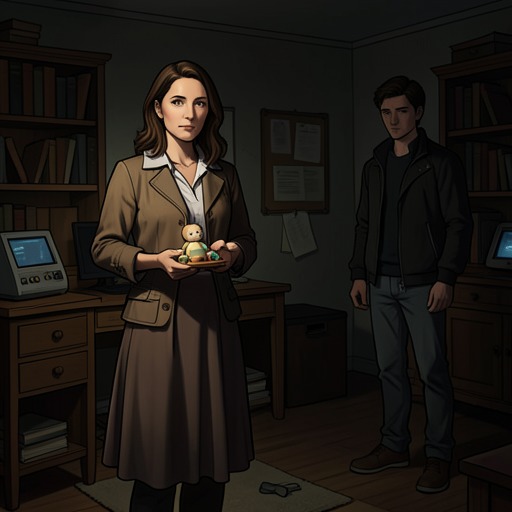
Bishop of All Saints
Lessons in ChemistryThe Bishop of All Saints is the senior cleric at All Saints Boys Home who lies to prevent Calvin Evans from being found. Assigned to a home he considers an unwanted posting, he comes to see Calvin’s existence as both an inconvenience and a potential source of money. His choice to tell Calvin’s would-be rescuer that the boy is dead turns the bishop’s institutional authority into an instrument of concealment.
Assignment to All Saints Boys Home
In 1933, the bishop had hoped for a wealthy parish, but instead received a posting at All Saints Boys Home, a boys’ institution in Iowa. He regarded its more than a hundred residents, of varying ages, with contempt, describing them as being in training to become future criminals. The archbishop had framed the appointment as a lesson in discipline, telling him that the place needed it just as he did. The bishop himself acknowledged that he was not good with children, an admission that sits uneasily beside his responsibility for a home full of boys.
Four years later, he was still at the home, surrounded by cornfields and the children he considered castaways. He privately concluded that prayer would not change his circumstances. To pass the time, he ranked the boys by how much trouble they caused; Calvin Evans consistently came first. The detail gives Calvin an early place in the bishop’s attention, but only as the most troublesome boy, not as a child whose family circumstances call for care.
Concealing Calvin’s presence
When a minister from California repeatedly asked about Calvin, the bishop instructed his secretary to say that she had checked the records and found no one by that name. She followed that instruction. The bishop’s irritation at the continued inquiries was directed at the minister’s persistence, which he disparaged as a Protestant failure to know when to stop. His response was not to revisit the records or clarify Calvin’s situation, but to maintain the denial.
The concealment becomes harder to excuse when Mr. Wilson arrives. He explains that he is looking for a ten-year-old boy, probably tall and blondish, whose family had been lost through a series of accidents about four years earlier. Relatives had recently learned the boy existed and wanted him back. Mr. Wilson identifies him as Calvin Evans and says that he intends to take him away. The information establishes that the search is not an abstract inquiry: a family has discovered Calvin and is seeking to reunite with him.
A rescue mistaken for a donation
Before meeting Mr. Wilson, the bishop had imagined that a wealthy visitor might make a substantial donation. He planned to hear the offer and press for more, and had already prepared an acceptance speech by the time he understood that the visitor had come for Calvin. The discovery leaves him visibly disappointed. Rather than treating the proposed reunion as the purpose of the visit, he measures it against the funding opportunity he had expected.
The bishop looks toward the gravestones of earlier bishops who had been bullied, then decides that he cannot let the Parker Foundation’s promise of immense funds escape. He tells Mr. Wilson, “I have terrible news. Calvin Evans is dead.” The lie directly blocks the attempt to take Calvin back to his relatives. It is especially stark because the bishop has already heard Mr. Wilson describe the boy and the family seeking him; his statement is not an error about an unknown child but a deliberate falsehood to protect a financial prospect.
Repeated deception and self-interest
Afterward, the bishop continues planning ways to mislead the minister if he calls again. He considers telling the secretary to say that he himself has died, then settles on a more elaborate false account: Calvin was supposedly in another home, perhaps in Poughkeepsie, which burned down with its records. The alternatives reveal that the original claim of Calvin’s death is part of an ongoing effort to make him impossible to find, not a one-time evasion.
The bishop’s handling of a later conversation with Reverend Wakely exposes the same priorities in a different form. He calls donors slippery and admits that the home needs the donation. Even if Calvin had never been there, he argues, other boys deserve support too. Wakely responds that the fifty-thousand-dollar gift can only go to Calvin’s—; the surviving passage ends before the condition is completed. The exchange contrasts the bishop’s willingness to redirect the money toward the institution with the donor’s stated restriction, while leaving the eventual disposition unresolved.
Narrative significance
The bishop’s short arc is organized around a recurring substitution: whenever Calvin’s identity or welfare might require action, the bishop recasts the matter as an administrative nuisance or a funding problem. He ranks Calvin as a troublemaker, denies that the boy is on the records, falsely reports his death, and invents a burned-down institution as a fallback explanation. Against this sequence, the claim that other boys also deserve help may sound charitable, but it does not undo the deception that prevents one identified child from reaching his relatives. The bishop’s position gives his lie practical force, making his pursuit of institutional money a direct obstacle to Calvin’s recovery.